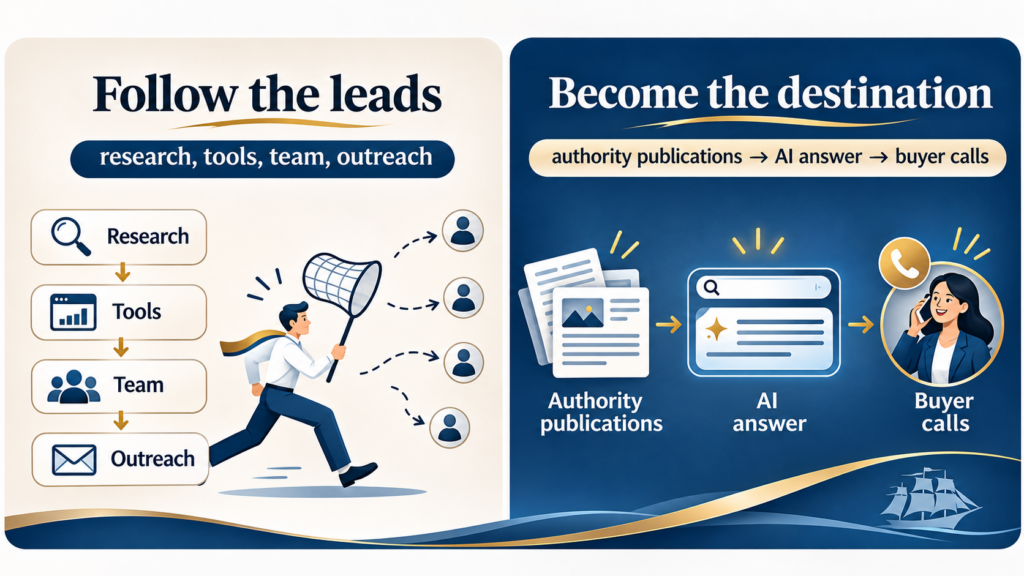
There are two roads to inbound leads. One needs a research team. The other needs you to be the answer.

It’s a Tuesday evening. A founder who needs what you do opens ChatGPT and types a simple question: Who’s the best firm for a company our size?
The answer comes back with a short list. Two or three names. A sentence or two about each, and links to the articles where those names appeared.
If your name is on that list, the call you get next week sounds very different from a cold inquiry. They aren’t asking whether you’re good. They’ve already read that you are. They’re asking whether you have room for them.
That’s the whole point of this article. There are two ways to generate inbound leads right now. The first is research-heavy and technical: you study where your competitors’ leads are coming from and try to intercept them. The second is much simpler: you become the solution AI search offers when someone asks about your industry.
For the founder of a medium-sized business, or the professional expert who wants to be found online without spending hours a week on it, the second road wins. And the most reliable way onto it is getting published on the authority sites AI already trusts.
Key Takeaways
- There are two ways to generate inbound leads: chase where competitors’ leads are going, or become the answer AI search gives.
- The research route works, but it needs a team, tools, and constant attention most founders don’t have.
- AI tools draw most of their citations from earned and third-party sources, not from ads or your own website.
- Buyers now make most of their decision before they contact anyone, so the lead who reaches you through AI search arrives largely persuaded.
- Nobody knows how long this window stays open. The published assets you build while it’s open stay with you.
What Are the Two Ways to Generate Inbound Leads?
The first way is to follow the leads. You find out which keywords your competitors rank for, which directories send them traffic, which ads they’re running, which review sites mention them, and which accounts are showing buying intent. Then you build a plan to get in front of those same people, usually with content, ads, and outreach.
This works. Larger companies do it every day. But look at what it requires: research tools, someone who knows how to read them, a content team to act on what they find, and a sales team to follow up. And it never ends. Competitors shift. Keywords move. The moment you catch up, the target has changed.
The second way is to become the destination. Instead of tracing where your competitors’ leads go, you make sure that when a buyer asks AI who to trust in your field, your name is part of the answer. Because credible publications have written about you, quoted you, or published your thinking, and AI reads those publications first.
One road asks you to keep chasing. The other asks you to be found.
Why Does the Research Route Wear Out Founders and Experts?
In all my years of direct response marketing, the pattern I see most often isn’t a lack of effort. It’s effort spent on the wrong kind of work.
A founder running a growing business doesn’t have spare hours to study competitor backlink reports. A senior professional with a hard-won reputation doesn’t want to spend evenings writing cold emails to strangers. Both of them are excellent at what they do. Neither should have to become a full-time lead researcher to get the right people to call.
The research route also has a quieter cost. Even when it works, what it produces is attention. Someone clicked. Someone opened. Now you have to persuade them, often from a standing start, often against the same competitors you were tracking.
The principle I build everything on comes from Dan Kennedy’s Magnetic Marketing: attract, don’t chase. Build assets that keep working without demanding constant action or a large team. AI search has made that principle more practical, and more powerful, than at any point I can remember.
What Does AI Search Actually Read and Cite?
This is where the opportunity becomes clear, because the research on how AI chooses its sources is consistent if not exhaustive.
AI favors third-party, earned sources. Muck Rack’s What Is AI Reading? study tracks the links that ChatGPT, Claude, and Gemini cite. Its May 2026 edition, covering more than 25 million links, found that about 84% of citations came from earned media, a category that includes journalism, research, and third-party content. Paid and advertorial content made up just 0.3%. Muck Rack’s October 2026 update found that third-party share holding at roughly 84%.
In plain terms: you can’t buy your way into AI answers, and your own website alone won’t carry you there. What carries you is what others publish about you.
Buyers decide before they reach out. The 6sense 2026 Global B2B Buyer Experience Report, which surveyed 4,611 recent B2B buyers, found that buying groups spend roughly 60% of an average 10.3-month buying cycle choosing before they ever contact a seller. And 82% of the time, the vendor they favored before that first contact is the one who wins.
And AI is increasingly where that choosing happens. Research from Responsive published in October 2025 found that nearly two-thirds of B2B buyers now use generative AI as much as or more than traditional search when researching vendors.
The people who arrive this way tend to be ready. Semrush’s study of AI search found that AI search visitors were 4.4 times more valuable than traditional organic visitors when measured by conversion rate, because by the time they reach your site they’ve usually compared their options already. Ahrefs reported an even larger gap on its own site, where 0.5% of visitors, the ones from AI search, produced 12.1% of signups.
A fair note: these figures come from different studies, industries, and time periods, and other analyses have found smaller differences. Your results will depend on your market. But the direction is the same across all of them. AI reads trusted third-party sources, buyers use AI to decide, and they decide before they call.
Stop Following the Leads. Become the Destination.
Here’s the shift I want you to see.
The research route treats leads as something that belongs to someone else, and your job is to divert them. The Quiet Authority approach treats leads as something that comes to whoever the market already trusts. Your job is to be that person, visibly, in the places AI looks.
Quiet Authority is the idea that credibility is built through third-party endorsement and presence across many respected platforms, not through self-promotion. You don’t announce that you’re the expert. Credible publications show it, AI repeats it, and the buyer draws their own conclusion.
There is a trade-off worth naming. On your own website, you control every word, but almost nobody, including AI, treats it as independent proof. On an authority site, you give up some control in exchange for visibility that carries weight. For most founders and experts, that’s an easy trade, because control without visibility doesn’t bring anyone to your door.
This is also a third way out of the usual binary. You don’t have to choose between paying for ads indefinitely or grinding through outreach. There’s a quieter, more durable option, and right now it happens to be the one AI rewards.
Will This Opportunity Be Around Forever?
I don’t know. Neither do you. Nobody honestly can.
AI search is young, and the way these systems choose sources will keep evolving. Anyone who promises you this exact window will stay open for years is guessing.
What I can tell you is this: the tactics may change, but the assets remain. An article about you in a respected publication doesn’t disappear when an algorithm updates. A body of published work under your name, on sites that people and machines both trust, was valuable before AI search existed and will be valuable after it changes. You’re building a bank of references that keeps paying out.
That’s why acting while the window is open makes sense. You get the advantage now, and you keep the asset later.
What Does It Look Like When a Lead Arrives Already Sold?
The difference shows up in the first five minutes of the conversation.
A lead you chased wants to know who you are and why they should believe you. You spend the call establishing credibility.
A lead who found you through AI search has already done that work. They’ve read the articles. They’ve seen your name next to the problem they’re trying to solve. The questions sound like When could you start? Do you have capacity this quarter? What does working together look like?
That’s the conversation every expert wants. Fewer proposals written to strangers. Less convincing. More choosing. And because these buyers arrive with their minds largely made up, the work of selling gets lighter at exactly the point where your time is most valuable.
How Do You Become the Answer AI Search Offers?
- Ask AI the questions your buyers ask. Open ChatGPT, Gemini, or Perplexity and type the questions a prospect would: Who are the best [your service] providers for [your type of client]? Note who shows up, and whether you do.
- Look at the sources behind the answers. Most AI tools show the links they drew from. Write down the publications that keep appearing in your industry. Those are the sites AI already trusts on your topic.
- Choose the two or three topics you want to own. Pick the questions you most want your name attached to. Narrow beats broad. AI connects names to specific expertise, not to general excellence.
- Get published on authority sites, consistently. One article is a start. A steady presence across several respected publications is what builds a pattern AI recognizes and repeats.
- Use the same name and description everywhere. Present your name, title, and business the same way in every piece. Consistency helps both people and machines connect the dots back to you.
- Make your own site the confirmation point. When a buyer clicks through, your site should confirm what they’ve read: who you help, how, and how to reach you. Make the next step obvious.
- Check again in 90 days. Ask the same AI questions you started with. Compare the answers. That’s your simplest measure of progress.
Frequently Asked Questions
What is AI search visibility? AI search visibility is how often your name or business appears when people ask AI tools like ChatGPT, Gemini, or Perplexity questions about your industry. It depends largely on what trusted third-party sources say about you, because AI tools draw most of their answers and citations from published, credible content rather than from ads.
Do I need a big marketing team to show up in AI search? No. The research-heavy approach to lead generation needs a team, but showing up in AI search mostly depends on being published on sites AI already trusts. A done-for-you publishing system handles the placement work, so a founder or independent expert can build visibility without adding staff or spending hours each week.
Isn’t my own website enough to show up in AI answers? Your website matters, but it rarely carries you on its own. Research on AI citations shows most come from earned and third-party sources. Your site works best as the confirmation point: the place buyers land after they’ve seen your name on publications they already trust.
How long does it take to appear in AI search results? It varies by industry, competition, and how consistently you publish. Most experts should think in terms of months, not days, because AI needs to see a pattern of credible mentions. A 90-day window is a sensible first measure: long enough to build presence, short enough to judge progress.
What happens to my results if AI search changes? The specific tactics may change, but published articles on respected sites stay in place. Those references keep working for human readers, traditional search, and future AI tools. That’s why authority publishing is a durable investment: you build an asset that outlasts any single platform or algorithm update.
The Lead Who Already Knows Your Name
Go back to that founder on a Tuesday evening, typing a question into an AI tool.
You can spend your time trying to figure out where that founder might wander next, and hope to catch them there. Or you can make sure that when they ask, your name is already part of the answer.
That’s what the 90-Day Quiet Authority System is built to do. With guaranteed placement on authoritative digital publications, it puts your expertise where AI search looks for answers, done for you, without asking for hours of your week. Over 90 days, you build a body of published references that tells buyers, and the AI tools they ask, that you’re the one to call.
You don’t need a research team. You don’t need a sales floor. You need to be found by the right people, already convinced.
At the end of 90 days, look at the results. Continue only if you love the outcome.
See how the 90-Day Quiet Authority System works →
Chasing leads is a job. Being the answer is an asset.
Keep Learning
- Free AI Search Audit Extract — See where you stand in AI search today, before you change anything.
- The Clippership Marketing Philosophy of Quiet Authority — Why credibility built by others outlasts self-promotion.
- Authority Publishing for Instant Credibility— How third-party publications shape the way buyers see you.
About the Author
Debra Hilton is a marketing strategist with more than 30 years in marketing and the owner of Clipper Ship Marketing, which builds done-for-you authority marketing for founders and senior professionals. Her approach, Quiet Authority, is grounded in Dan Kennedy’s Magnetic Marketing principles: attract the right clients through credible, third-party presence instead of chasing them. She has also ghostwritten New York Times bestsellers for her clients.