Why what other people publish about you now does more to decide the deal than anything you say, and how to make sure it says the right thing.

Your next client has probably already made up their mind about you. You just weren’t there when they did it.
They read an article that quoted you, or didn’t. They asked an AI assistant to name the strongest firms in your specialty, and it gave them three names. They noticed your name in a trade publication, on a podcast page, in a roundup somebody else wrote. By the time they fill in your contact form, most of the deciding is done.
So here’s the direct answer to the question in the title. Third-party publications shape how buyers see you because buyers trust what others say about you more than what you say about yourself. They do most of their evaluating before they ever speak to you. And AI search tools, which more and more buyers use to build their shortlists, pull most of their answers from earned, third-party sources rather than from your website or your ads. An article about you in a credible publication works as a reference letter you don’t have to ask for. It’s read in the rooms you aren’t invited into.
In more than 30 years of marketing, and many of them spent ghostwriting books for experts whose names ended up on bestseller lists, I’ve watched the same thing happen again and again. The moment someone else puts your name in print, people stop hearing a sales pitch and start hearing a reputation. That shift is what I call Quiet Authority: credibility built through third-party endorsement and presence across many platforms, rather than through self-promotion.
This article explains why that shift matters more now than at any point in my career, what the research says, and how to start building it on purpose.
Key Takeaways
- B2B buyers spend only about 17% of their buying time with suppliers, and that’s shared across every firm they’re considering.
- Buyers usually pick a favorite before they ever contact a seller, and that favorite wins most of the time.
- AI assistants draw most of their citations from earned media. Paid and advertorial content barely registers.
- A trusted outside voice raises your credibility far more than your own marketing claims can.
- Third-party authority is an asset you build once and keep. It works while you’re busy serving clients.
Why Can’t Your Own Marketing Carry the Weight Anymore?
If you run a high-ticket service business, you already know the frustration. You’re good at what you do. Your clients stay. Your referrals are warm. But new prospects who don’t know you yet keep choosing a competitor who, frankly, isn’t better than you. They’re just more visible.
It’s tempting to fix that by saying more about yourself: a sharper website, more posts, a bigger ad budget. I understand the instinct. I’ve seen many talented professionals pour money into it.
The problem is structural. Everything on your own website, in your own ads and on your own social feed carries the same quiet label in the buyer’s mind: the firm said this about itself. A smart buyer discounts it, and the higher the fee, the bigger the discount. When you’re asking someone to trust you with a five- or six-figure engagement, your own claims about how good you are can only take you so far.
There’s a second problem, and it’s newer. Buyers aren’t only reading anymore. They’re asking. They type “who are the best [specialty] firms for [situation]” into ChatGPT, Gemini, Claude or Google’s AI answers, and they get a short, confident list. If your name isn’t on it, you never get the chance to make your case.
That’s the gap I see most often when I run an AI search audit for a professional services firm. The firm isn’t losing on price or quality. It’s losing on being named. The competitor turns up in the sources AI trusts, and the firm doesn’t.
I recently ran a search audit for a prospective client in the B2B training industry. This client spends thousands of dollars on advertising each month and has developed some groundbreaking tools over 50 the past years. They only named as the answer for 3 out of 170 questions, and were not recommended at all. Prospects were directed to organizations with less experience and far less proof.
None of this means your website doesn’t matter. It means your website is where buyers go to confirm a decision. It’s rarely where the decision gets made.
What Does the Research Say About How Buyers Decide?
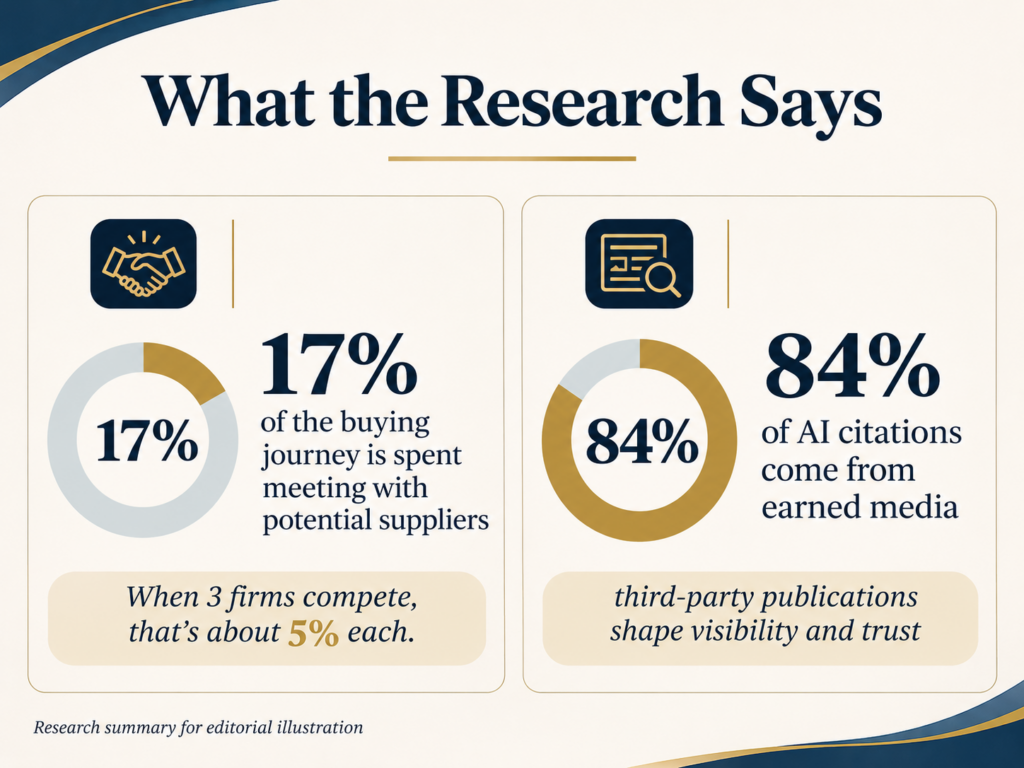
The evidence here is unusually consistent. Four bodies of research point the same way.
Buyers spend very little time with you. Gartner surveyed 750 B2B buyers involved in complex purchases and found they spend just 17% of their buying time meeting with potential suppliers. If three firms are in the running, each one gets roughly 5% of the buyer’s attention. The other two-thirds or so of the time goes to independent research and conversations with peers. That’s where your reputation either does its work or doesn’t.
Buyers choose early, and early choices stick. 6sense’s 2026 Global B2B Buyer Experience Report found that buying groups choose the vendor they already favored before contacting a seller 82% of the time. Vendors left off the initial shortlist have less than a 10% chance of winning. Buyers spend roughly 60% of an average 10.3-month buying cycle in the selection phase, which is the stretch before they reach out. The same report found that 21% of buyers already cite large language models as an influence on their view of vendors before first contact.
AI reads earned media, not ads. Muck Rack’s May 2026 What Is AI Reading? report analyzed more than 25 million links cited by ChatGPT, Claude and Gemini. Earned media accounted for about 84% of citations. Paid and advertorial content accounted for 0.3%. One caveat in fairness: Muck Rack’s “earned” category is broad. It includes journalism, academic research, government sources, encyclopedic sites and third-party corporate content. But that breadth makes the point rather than weakening it. AI answers are built almost entirely from what other parties publish.
Outside voices move credibility. In the 2026 Edelman-LinkedIn B2B Thought Leadership Impact Report, a survey of 1,135 executives across seven countries, 81% said a trusted outside voice amplifying a company’s thinking raises their view of its credibility “a lot” or “a great deal.” Two-thirds said it makes them meaningfully more willing to consider that company as a vendor. And 59% of final decision-makers said a vendor’s poor or absent thought leadership contributed to that vendor being dropped from consideration. (These are self-reported attitudes, not tracked deal outcomes, and the report is co-sponsored by LinkedIn. Even so, the direction is hard to miss.)
Put those together and the picture is plain:
- Buyers decide mostly without you.
- They decide early.
- The tools they increasingly use to decide pull from third-party sources.
- Third-party voices carry far more credibility than your own.
Your marketing is in the room for about 5% of the conversation. Third-party publications are in the room for the rest.
What Is Authority Publishing, Really?
Here’s where I part ways with much of the conventional advice.
Most people hear “third-party publications” and think of PR: pitch a journalist, hope for a feature, frame it if it lands. That has value. But it treats publication as an event, a lucky moment of attention that fades by next week.
I think of it as infrastructure.
Every credible article, interview, podcast page or syndicated piece that names you, explains your specialty and links back to you becomes a permanent part of the record buyers and AI systems read. It doesn’t expire when the news cycle moves on. It builds up. Ten placements across respected platforms don’t just reach more people than one. They create a pattern, and patterns are what both humans and AI models treat as evidence.
That’s the heart of Quiet Authority. You don’t tell the market you’re the expert. You make sure the market keeps finding you described as one, by sources it already trusts, wherever it looks.
It’s also why I’m comfortable with something that might sound strange from a marketer: the specific tactics will change. Search will keep evolving. AI tools will change how they choose sources. But a bank of credible, third-party references to your name and your expertise stays put. It’s an asset, not a campaign.
How Do Third-Party Publications Actually Change Buyer Perception?
Three things happen when a buyer meets you through a publication rather than through your own marketing.
The frame changes from pitch to reputation. A buyer reading your website is evaluating a seller. A buyer reading an article that quotes you is learning about an expert. Same person, same expertise. The setting changes how the information lands.
The risk feels smaller. High-ticket buyers are rarely afraid of paying too much. They’re afraid of choosing wrong and having to explain it. A visible, third-party track record gives them something to point to: “I didn’t take a flyer on an unknown. Look where this person has been featured.”
You become nameable. This is the AI-era shift. When an assistant builds an answer about your specialty, it looks for sources that connect your name to the topic. Each credible placement strengthens that connection. Without it, you may be excellent and still be left out of the answer entirely.
This is exactly what our Multicasting work at Clipper Ship Marketing is designed to do. We take a client’s specialty, offer and link and turn them into a set of formats, including articles, news pieces, press releases, podcast content, slideshows and video, then place that content across authoritative digital publications. The goal isn’t a single headline. It’s a durable footprint that both buyers and AI systems encounter again and again.
What Can You Do This Week to Start Building Third-Party Authority?
You don’t need a publicist or a big budget to begin. You need clarity and consistency. Here’s where I’d start.
- Ask AI about yourself, the way a buyer would. Open ChatGPT, Gemini or Perplexity and type the question your ideal client would ask, such as “Who are the leading [your specialty] advisors for [your client type]?” Note who’s named and which sources are cited. That list is your real competitive landscape.
- Write down the one thing you want to be known for. Not five things. One specialty, stated so a stranger could repeat it. Publications, and AI models, reward clear, consistent associations between a name and a topic.
- Audit your existing third-party footprint. Search your name and your firm’s name, and list every place outside your own properties where you appear: articles, directories, podcast pages, association sites, quoted comments. Note which mention your specialty clearly and which link back to you.
- Turn one strong idea into several formats. Take your best insight, the thing clients thank you for explaining, and shape it into a short article, a few quotable lines, and a set of talking points for a podcast or interview. One idea told well in many places beats many ideas told once.
- Pick three publications your buyers already trust. Trade journals, association newsletters, respected industry blogs, niche podcasts. Smaller, focused outlets often matter more than you’d expect. Muck Rack’s research found that some AI models cite niche and mid-tier outlets more often than major publishers.
- Keep every mention consistent. Same name, same title, same specialty description, same link, everywhere. Consistency is how scattered mentions add up to recognized authority.
- Measure by being named, not by likes. Every few months, ask the same AI questions from Step 1. The question that matters isn’t “Did people engage?” It’s “Am I showing up in the answer now?”
If you’d like a head start on Steps 1 and 3, our free AI Search Audit shows how your brand compares with your main competitors in AI search and where the gaps are.
Frequently Asked Questions
What counts as a third-party publication? A third-party publication is any credible outlet you don’t own that publishes content naming you or your firm. That includes news sites, trade journals, industry blogs, podcast show notes, association newsletters and syndicated articles. What matters is independence and credibility. Buyers and AI systems treat these sources as evidence, not self-promotion.
Isn’t this just PR with a new name? Not quite. Traditional PR usually chases individual moments of coverage. Authority publishing treats each placement as a lasting asset that builds up over time. The aim is a consistent, multi-platform record linking your name to your specialty, one that buyers and AI tools keep finding long after any single story’s news value has faded.
Do paid placements or advertorials help with AI search? Very little, according to current evidence. Muck Rack’s May 2026 analysis of more than 25 million AI-cited links found that paid and advertorial content made up just 0.3% of citations, while earned media made up about 84%. Advertising can still drive awareness, but it rarely shapes what AI says about you.
How long does it take for third-party authority to influence buyers? It builds gradually rather than all at once. Individual placements can be found as soon as they’re published, but the stronger effect, being consistently named by AI tools and recognized by buyers, comes from accumulation. Plan in quarters, not weeks, and check progress by repeating the same AI search questions regularly.
I’m a small firm. Can I compete with bigger names? Yes. Third-party authority rewards clarity and consistency more than size. A firm known clearly for one specialty, mentioned across several focused, credible outlets, can appear in AI answers alongside much larger competitors. Niche and mid-tier publications are often especially valuable, because buyers in your field trust them and AI models cite them.
The Room You’re Not In
Go back to that buyer from the opening. The one who made up their mind before contacting you.
You can’t be in that room. None of us can. Buyers will keep doing most of their deciding in private, and more and more of that private research will run through AI tools that have never heard your sales pitch and never will.
But your reputation can be in that room. An article that explains your thinking can be there. A podcast where you said something useful can be there. A pattern of credible sources naming you as the person who does this well can be there, quietly making your case while you’re busy doing the work you’re known for.
That’s the opportunity. Not louder marketing. Better evidence, placed where buyers already look.
In all my years in this business, I don’t get excited about tactics. But this, building an asset that keeps speaking for you in rooms you’ll never enter, is the most promising and affordable strategic opportunity I’ve seen for professionals who would rather be known than be loud.
Let other people’s words do what your own words can’t.
Keep Learning
- Get Your AI Search Audit : See how your brand compares with your competitors in AI search, and what to fix first.
- Why being named by AI is becoming the new first impression.
About the Author
Debra Hilton is a marketing strategist, novelist and the founder of Clipper Ship Marketing, which builds done-for-you authority marketing for high-ticket B2B service providers. Over more than 30 years in marketing, including an elite ghostwriting practice whose clients include New York Times bestselling authors, she has helped experts turn what they know into reputations that work on their behalf. Her approach, Quiet Authority, helps founders and professionals become visible in AI search and credible through third-party endorsement, without having to become self-promoters. She lives in Vero Beach, Florida.
Sources
- Gartner, B2B buying journey research (750 B2B buyers; 17% of time with suppliers): https://www.gartner.com/en/newsroom/press-releases/2020-09-15-gartner-says-80–of-b2b-sales-interactions-between-su
- 6sense, 2026 Global B2B Buyer Experience Report (82% choose pre-contact favorite; <10% win rate off shortlist; 60% of 10.3-month cycle; 21% cite LLMs): https://www.demandgenreport.com/?p=55214
- Muck Rack, What Is AI Reading? May 2026 (84% earned; 0.3% paid/advertorial; 25M+ links): https://muckrack.com/blog/ai-citations-for-pr
- Muck Rack niche-outlet finding: https://mediacopilot.ai/claude-cites-journalism-less-muckrack-study/
- Edelman-LinkedIn, 2026 B2B Thought Leadership Impact Report (1,135 executives; 81% / 66% / 59%): https://ppc.land/82-of-b2b-buyers-value-thought-leadership-more-as-ai-spreads-edelman-finds/